Tuesday, March 12, 2013

Fifty Shades of Wicked

Franco shows Kunis the way in Oz the Great and Powerful.

««« Oz the Great and Powerful. Written by Mitchell Kapner & David Lindsay-Abaire, based on the novels by L. Frank Baum. Directed by Sam Raimi. 

Maybe I need a brain, but I like Sam Raimi’s Oz the Great and Powerful. And apparently so do audiences, who gave it a crushing victory over Jack the Giant Slayer in last week’s fable-on-fable duel at the box office.
          L. Frank Baum (1856-1919) wrote 17 books set in his fantasy world of Oz, so you’d think his work would be a prime candidate to become a Hollywood franchise. Trouble is, Baum’s books no longer present the definitive version of their own universe. Instead, multiple generations of kids grew up watching the 1939 Victor Fleming adaptation of just one of his books, The Wizard of Oz—on TV, usually around Thanksgiving time. Now Oz is synonymous with Dorothy, ruby slippers and cowardly lions, regardless of the fact that Baum created dozens of other memorable heroines and villains. Try a Baum reboot and you invite the wrath of millions of fanatical fans, ready to lay waste to sacrilege as utterly as a swarm of flying monkeys.
          Until now, the only reimagining of the Baum universe that has seen serious traction is Stephen Maguire’s Wicked: The Life and Times of the Wicked Witch of the West (1995), the bestselling novel that gave rise to a Broadway musical. Maguire’s decidedly womynish take on the back story of the Wicked Witch, Glinda, and the Wizard seems to have primed some of our feminist sisters to expect something similar of Raimi’s film (see, for instance, here: jezebel.com/5989268). But of course, there was nothing particularly feminist about the 1939 movie. True, L. Frank Baum himself had convincing suffragist credentials. But as we already have established, Oz belongs to Judy Garland now, not Baum.
          Instead, Great and Powerful offers the origin story of the Wizard himself, aka Oscar Zoroaster Phadrig Isaac Norman Henkel Emmannuel Ambroise Diggs (James Franco). We meet him first here as a two-bit carnival showman in 1905 Kansas, bilking audiences out of coin with his low-rent spectacles. He’s also something of a womanizer, which gets him in trouble with the circus strong man (Tim Holmes). Lighting out for safer pastures, he flies his balloon into the path of a plains twister—and ends up you-know-where.
          He finds an Oz as politically polarized as the 113th US Congress. The three resident witches, sisters Theodora (Mila Kunis), Evanora (Rachel Weisz) and Glinda (Michelle Williams) are locked in a death struggle over control of Emerald City, each accusing the other of poisoning their father. More out of hope than evidence of his magic skills, they take the stranger as a great wizard, savior of the kingdom. After seeing the Emerald City’s treasury (lots of gold but, alas, no emeralds…), Oscar is in no hurry to correct them. Theodora in particular falls pretty hard for Oscar’s smooth carnival patter—with wicked consequences for all.
          With its three powerful women executives aching for a man to come and settle their troubles, this fairy tale is admittedly a disaster from a feminist perspective. No doubt, Great and Powerful plays into certain modern anxieties of the post-feminist culturescape—namely, the fear that women’s empowerment, despite its power suits and sensible shoes, just isn’t satisfying enough. Indeed, how else to explain the continued existence of Cosmopolitan magazine, or the success of Fifty Shades of Grey? If you bet whether many successful women out there—if not witches, exactly—would give it all up for Franco’s kind of handsome, shit-eating grin, you’d win that wager.
          Dig a little deeper, however, and the news isn’t all bad for feminists. After all, if the witches’ attraction to Oscar represents some repressed desire for male control, then it’s a pretty weak version of patriarchal power. Smoke and mirrors, actually—the kind that the heavenly Michelle Williams, as the good witch Glinda, winks at and permits to exist.
          But the most inconvenient truth is that we need Raimi’s phallocentric story now more than we need another Tangled, Brave or similar tale of girls’ empowerment. Newsflash: there’s no shortage of strong, plucky heroines in Hollywood anymore. Quite the opposite, girls kick butt just about every mainstream fantasy these days, big screen or small. Meanwhile, one big question remains unanswered after the feminist revolution: what does it really mean to be a man today, if the traditional models of protector and provider have become not just outmoded, but offensive? In Great and Powerful, we see Oscar learn that becoming a man isn’t about being great and powerful at all, but instead something very basic, yet ultimately more fulfilling. It’s a story that the current generation of young males, who are disconnected and restive and falling behind their sisters in virtually every measure of educational achievement, need to hear.
          Not that kids need to be consciously aware of any of this. Refreshingly, Raimi (Evil Dead, Army of Darkness, Drag Me to Hell) eschews cynical Dreamworks-style triangulation between adults and kids. There’s no smug double entendre in the script by Mitchell Kapner and David Lindsay-Abaire, no knowing cultural references meant to bemuse hipsters and sail over the heads of children (aside from allusions to the 1939 movie, of course…). This a kid’s movie that is happy to be just that. And that’s not nothing. 
© 2013 Nicholas Nicastro

Tuesday, March 5, 2013

Go Forth and Multiply

Terah Maher ad infinitum in Choros.


«««« Choros. Film by Michael Langan & Terah Maher. Available for streaming at http://langanfilms.com/choros.html.
«««« Solipsist. Directed by Andrew Huang. Available for streaming at http://vimeo.com/37848135.

Everybody complains about the weather, but nobody does anything about it. Likewise, many film critics complain about the lack of inspiration, the dismaying sameness of mainstream American movies—yet they go on reviewing the same feature product, week after week. Entertaining as they may be, does anybody really believe that The Avengers or Wreck It Ralph represent the very best we can do? Is Jack the Giant Slayer really as imaginative as it gets?
          This week we do something about it. There are two experimental short films available now for online streaming that are well worth checking out, and they don’t even demand ten of your hard-earned bucks. In exchange for twenty-three minutes of your time, these films will 1) blow your mind, and 2) restore your faith that it’s still possible to do something truly visionary with a moving picture camera.
          Michael Langan and Terah Maher’s Choros (2011, 13 minutes) is a seductively hypnotic dance film. Using an advanced video compositing (essentially, combining multiple images into one), Langan captures 32 temporally-offset images of a dancer (Maher) as she moves to Steve Reich’s “Music for 18 Musicians”. Though the idea is simple in principle, the results are spectacular: Maher’s movements are ramified in almost sculptural fashion, pouring through postures in a way that suggests some third mode of being between stillness and movement.
          The filmmakers are well- aware of the historical legacy of their project. In the late 19th century, Eadweard Muybridge used multiple still cameras to capture successive images of moving figures, making the world look at movement in a new way (and, in the process, presaging the new art of cinema). In 1968, Normal McLaren used conventional celluloid superimposition to make his classic Pas de Deux. The technology of McLaren’s time, however, permitted him to shoot his dancers only in black and white, with no pauses in motion, and only against a black background. Modern video compositing freed Choros of these limitations—a liberation the filmmakers wryly celebrate when they describe their film as a pas de trente-deux.
Duchamp's "Nude Descending a Staircase"
          In an important sense, though, this film harkens not to other films, but to modernist landmarks like the Marcel Duchamp painting Nude Descending a Staircase (1912). Where Muybridge essentially taught his audiences to see cinematically, to give in to an illusion of movement built out of still elements, Langan and Maher follow Duchamp in envisioning a subject that is neither still nor moving, but in a fluidic state that is validly (and entrancingly) its own. As Maher’s body(ies) evoke helices, landscapes, butterflies and a thousand other fleeting forms, we begin to appreciate what she and Langan are on to here: a merging of traditional art and modern technology that multiplies the expressive power of both.
          Equally good is Andrew Huang’s astonishing Solipsist (2012, 10 minutes). A visual symphony in three movements, this combines elements of dance, costume, puppetry, video compositing and old-fashioned physical effects into a wordless poem to growth, evolution, and enlightenment. Movement one presents two dancers swaying in unison as they are gradually enveloped by a riot of vaguely organic detritus, until they become a gently undulating polyp. In movement two, worm-like, feathery organic forms swirl and pulse in an alien ocean, combining into ever more complex, baroque forms. Or are they nerve cells in a developing brain, boot-strapping their way toward consciousness? For the purposes of Huang’s theme, it hardly seems to matter whether these are dendrites in an infant’s cerebrum, or dwellers in the sub-ocean of Europa.
The dance of evolution plays on in Solipsist.
          Movement three gives us two figures on a beach, oddly aloof to each other until they merge in a surprising way (hint: think about the party scene in Donnie Darko). In each of these tableaux, Huang seems to allude to evolution and sex and development—the essential dramas of organic life—but also conjugations and conjunctions more spiritual in nature. In either case, the film seems to belie the isolation implied by its title.
          Perhaps Huang is suggesting the distinction between physicality and spirituality means not much. Or perhaps he’s just messing around with cool imagery. In any case, there’s more to marvel at and more to think about in Solipsist than in all 139 minutes of Terrence Malick’s The Tree of Life.
          One can’t help thinking that visionaries like Langan and Huang are like the bright, quick mammals waiting for their turn during the twilight of the dinosaurs. Choros is in regular rotation on European television, but as described on Langan’s website, it is “not coming to a theater near you.” Solipsist got made after Huang raised a mere $9000 on Kickstarter.com (the budget for Tree of Life: $32 million). The multiplex may be wall-to-wall T. rexes for now, but rest assured, the asteroid is coming. 
© 2013 Nicholas Nicastro

Wednesday, February 27, 2013

Cycles of Enlightenment


Mild ones on the roof of the world in The Highest Pass.

* * The Highest Pass. Written by Adam Schomer. Directed by Jon Fitzgerald. Available on Netflix.

Anyone interested in India and who enjoys Top Gear-esque road adventures should be up for Jon Fitzgerald’s The Highest Pass.
           The eponymous pass is a road in northern India that boasts the highest stretch of “motorable” pavement in the world. This is above 18,000 feet, accessed first through dizzying Indian traffic, then breathtaking landscapes that seem to threaten avalanche with every switchback. Fitzgerald documents a trip upcountry by a handful of Americans, led by Anand Mehrotra, a 27 year-old Indian guru and avid biker. Awkwardly, most of Anand’s followers hunger not just for spiritual development, but for basic experience on motorcycles. The spectacle this film presents—of two-wheel novices risking their necks in a country where road rules seem optional—raises issues far more basic than spiritual enlightenment. As in, does anybody get killed?
          Largely told through the eyes of Schomer, this adventure is a purely elective affair. No one is delivering life-saving medicine to remote villages here. Instead, the entourage of LA-based model/actors, stunt men and graphic designers seek to find their “higher selves”, to step outside the trap of their constrained, materially comfortable lives. Anand himself suggested the trip, apparently in direct defiance of an astrological “prophecy” that he would die in an accident at the age of 27. Leading his pack of mild ones to elevations usually visited only by airliners, the smooth-talking guru dispenses the equivalent of spiritual comfort food to his followers as they bounce off truck fenders and gasp for oxygen. More than once, Fitzgerald and Schomer hint that Anand is nuts.
          On an obvious level, The Highest Pass seems like a over-produced vacation video. It takes some cynicism—but not much—to make fun of these guys, waxing karmic in their Maui Jim shades. Listening to them go on about “powering through adversity” as virtually the entire population of rural India “powers through” adversity they’ll never imagine is hard to take. But let’s be gracious: stunt men and model/actors are entitled to their shares of enlightenment too. While Schomer and his crew might seem like spiritual tourists, there are far, far worse kinds of tourists to be in this world. It may be painful to hear them talk, but the stunning Himalayan vistas captured by Dean Mitchell would be worth it, even with the sound turned off.
          The Highest Pass strays into questionable territory when the expedition reaches a pass blocked by a June snowstorm. Normally this would entail a two day delay. But Anand, who seems strangely impatient for a guru, insists on traversing the pass immediately, pressuring the Indian road crew to plow farther, faster. The bikers take on a degree of risk in this, which is their prerogative. But nobody seems to have asked whether it’s fair to the road workers, let alone anybody else following them down a prematurely-opened road, to expose them to increased risk of avalanche. Never mind karmic liberation—what about moral hazard?
© 2013 Nicholas Nicastro

Thursday, February 21, 2013

Doctors Within Borders

Hoss and Zehrfield weigh their options in Barbara.

* * * 1/2  Barbara. Written by Christian Petzold and Harun Farocki. Directed by Christian Petzold. 

There’s developing a small but potent sub-genre of post-1989 European films about life behind the Iron Curtain. This column only selectively covers foreign cinema, but has already lauded two examples in The Lives of Others (2006) and 4 Months, 3 Weeks and 2 Days (2008). Now we have Christian Petzold’s impressive Barbara, which was Germany’s submission for the 2013 Foreign language feature Oscar. The Academy did not include it on the list of final nominees, but that doesn’t mean you should snub it too. It’s better than 95% of the Hollywood scheiße up for any award that evening.
            It’s in the dark days of 1980 when Dr. Barbara Wolff (Nina Hoss) arrives at her new post in a provincial hospital in the north of the DDR (communist East Germany). She’s being punished, actually: for the crime of applying for a visa to leave for the West, she was imprisoned and then banished to the hinterlands, where she is regularly harassed by the Stasi (the east German secret police).
            Her suffering has left her bitter and all too eager to show her professional superiority to her smallville colleagues. Nor has she necessarily given up on her plans to escape, by any means necessary. As sketched in the smart and true script by Petzold and Harun Farocki, Barbara can only cope with her misery by minimizing her human contacts. But she doesn’t count on the instincts aroused by a young female patient in even more trouble (Jasna Fritzi Bauer), nor on meeting Andre (Ronald Zehrfield), a brilliant, compassionate physician who, once upon a time, was also run out of Berlin for his sins. The theme is familiar one for doctors in extremis: having to decide whether to live, or to save the lives of others.
            At a time when seriousness is only forgivable when it’s cut with quirkiness, Barbara is refreshingly retro. Told in a kind of patient sotto voce, it contains no gratuitous thespian fireworks, no “life is beautiful” funny-‘cause-its-true bullshit. The only responsibility Petzold seems have felt is to be true to his characters and their predicament. His leading lady, Nina Hoss, gives only what the character would, and when she gives more makes you feel the strain. Overall, this film has some of the authenticity and heft of Rainer Werner Fassbinder (The Marriage of Maria Braun, Berlin Alexanderplatz), except that Petzold is better at the craft of filmmaking at this stage of his career, and gives the impression (unlike Fassbinder) that he actually likes his characters.
            Indeed, the worst thing about Barbara is that it dismisses itself too quickly. It ends the end of a dramatic choice, but never resolves the question of how Barbara learns to live with her de facto imprisonment. After all, there are nine long years to go before the Wall comes down. It might have been nice to see her reaction to that sudden freedom, when a stroll across a certain field stopped having existential stakes, but just a stroll again.
© 2013 Nicholas Nicastro

Wednesday, February 13, 2013

Dial M for Meds


Rooney Mara on the couch in Side Effects.

* * * Side Effects. Written by Scott Z. Burns. Directed by Stephen Soderbergh. 


There’s a good chance you’re already on drugs. More than 10% of all Americans—around 35 million people—were on anti-depressants in 2011. The figure for women between the ages of 40-59 was 20%. And that’s not even counting other sorts of medications, such as ones for cholesterol (still the #1 most prescribed class), painkillers (#3), heart meds (#4), “anti-ulcerants” (#8), tranquillizers (#11), and sedatives (#20). In large part, the medicated nation envisioned by Aldous Huxley in Brave New World is already here, except that Huxley was a little naïve to assume there would be only one drug on offer.
            All those drugs and their picturesque side-effects naturally lead to a degree of anxiety. Our word “pharmacology”, after all, is rooted in a Greek word that meant both “remedy” and “poison.” Steven (Ocean’s Eleven, Sex, Lies and Videotape) Soderbergh’s new Side Effects trades deftly in this unease. Or more precisely, it starts to, until it veers off into a standard thriller territory.
            We meet Emily (Rooney Mara) as her husband (Channing Tatum) is about to get out of prison for insider trading. As often happens in these situations, she falls apart emotionally just as her ordeal seems to be ending. Desperately depressed, she turns to Dr. Banks (Jude Law) for help, who puts her on a series of meds to lift her mood. They ultimately hit on a new, not entirely tested drug that seems to help—except for the sleepwalking, sleep-cooking, and—to Dr. Banks’ shock—sleep-murder. The cops find her husband stabbed to death as Emily huddles in bed, unable to remember how he got there.
             The script by Scott Z. Burns (Contagion) sets up this promising premise, and primes it with some delicious complications. The doctor’s judgment, you see, may have been influenced by the fact that he’s being paid $50,000 to “evaluate” the drug, which means prescribing it to patients who might not entirely understand the risks. Banks, meanwhile, starts to have his suspicions about Emily’s story—whether there's more to her depression than it appears. Is he on to something or just rationalizing away his own responsibility?
            One of the possible side-effects of all this chemistry, Burns wants to suggest, is the shifting of responsibility, and therefore of guilt. In this sense Side Effects promises to be a pharmacological update on the classic Hitchcockian thriller, such as The Wrong Man, preoccupied with the question of culpability. But that’s only until the film shifts from being The Wrong Man and becomes Dial M for Murder—that is, to a more or less standard battle of wits between Banks, Emily, and Emily’s former shrink (Catherine Zeta-Jones).
            Not that the battle isn’t entertaining. Without giving away too much, Rooney Mara (who played the title role in the US version of Girl With the Dragon Tattoo) commands the screen even as she plays it listless and dejected; Jude Law manages to swing from “doing no harm” to toxic avenger without seeming wholly unsympathetic. Neither of these are easy tricks. Soderbergh, one of our most consistently versatile directors, is always in control.
            Yet there’s no escaping the feeling that there was a potentially terrific movie here that contents itself to be merely “good”. As depression goes from stigma to illness to existential condition, there are questions that deserve posing, much less answering. And if intelligent guys like Soderbergh won’t try, who will?
© 2013  Nicholas Nicastro

Wednesday, February 6, 2013

The Deadness


* * * Warm Bodies. Written and directed by Jonathan Levine, based on a novel by Isaac Marion. 

Corpse (Nicholas Hoult) meets girl (Teresa Palmer) in Warm Bodies.
Before the craze for the undead at the multiplex, you were most likely to hear about zombies in the context of philosophical thought-experiments on the nature of consciousness. That is, how do you know that other people have minds like you, if all you really know is their outward behavior? If a zombie goes through all the motions of being a person with a full inner life, but really has no mind at all, could you tell the difference? More disturbingly, what if your brain were set up to make you believe you are conscious, when you’re really just a zombie yourself?
            Not that Jonathan Levine (50/50, The Wackness) necessarily had any of that in mind when he made his zombie romance, Warm Bodies. Outwardly, this is just a twist on what has become a too-familiar genre. After the usual zombie apocalypse, we meet a dead-ender with a difference: known only as “R”—from a fragment of his forgotten name—the hero (Nicholas Hoult) is an ambulatory corpse with a full set of existential hang-ups. Bemoaning the monotony of being dead, R shambles around a wrecked airport, wondering if there’s anything more to post-mortem life. Mere teenage self-consciousness isn’t enough for this zombie to suspect he is, in fact, alive. He hungers for brains, yet he hungers for something more.
            “More” finally comes in the person of Julie (Teresa Palmer), a living, breathing female vaguely resembling Kristin Stewart, but with the spunk to wake the dead. Smitten at first sight, R doesn’t devour her but saves her life. She, in turn, becomes intrigued by her unusual savior, who lacks a pulse but seems more humane than her “shoot ‘em on sight” vigilante father (John Malkovich). Love, you see, has the effect of reversing the zombie plague—an effect that starts with R and spreads through other corpses that are still on the fresher side. “Don’t be creepy…” the zombie tells himself as he tries not to stare at her.
            True, in the abstract this sounds like B.S., and even worse, high-concept B.S.. But Levine’s script, based on Isaac Marion’s novel, is witty enough to distract from the wackness of its “love conquers death” theme. Instead of Night of the Living Dead, the classic he seems to have in mind is Shakespeare’s tale of star-cross’d lovers, compelled by their passion to defy their warring clans.  (If Julie = Juliet, then R obviously doesn’t stand for “Randy”). Levine even gives the couple a balcony scene.
            In short, the film is mildly hokey but also mildly clever. Indeed, the latent humanity of Levine’s walking dead raises bigger questions than a mere rom-com has any business asking. Instead of the usual raging virus, it’s the lack of real interaction that makes zombies of us all; in a flashback, Levine shows us the world shortly before its collapse, as the living ignore each other  in favor of smart-phones and tablets. The zombie next to you may not want your brains as much as he wants to squeeze in his next move on Words With Friends.
            Today’s zombie is just the horror equivalent of all the robots and replicants and cyborgs of science fiction, challenging us to define what it really means to be human. In most instances, the deep issues are never explored, because the humans always respond first by blowing zombies’ brains out. Sometimes the shooters even seem to enjoy it—a pleasure that, in a more reflective treatment, might prompt the question of who is really dead inside.
            For exhuming these and other  hidden themes, Warm Bodies isn’t wacked.
© 2013 Nicholas Nicastro

Wednesday, January 30, 2013

There Will Be Blood

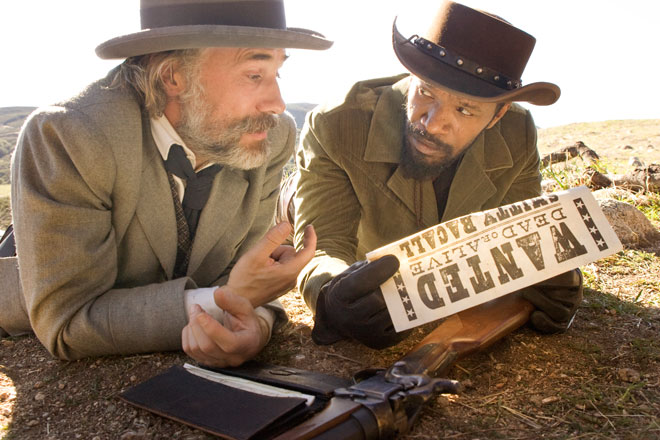
Waltz and Foxx can shoot straight in Django Unchained.


«« Django Unchained. Written and directed by Quentin Tarantino. 

It’s taken a while for this writer to get around to Quentin Tarantino’s latest opus, Django Unchained.  This has nothing to do with his craft as a filmmaker. On a tactical, scene-by-scene level, Tarantino’s work is unique. It crackles with an energy that is purely his. In an industry where the pre-sold commodity, the sure thing, is valued above everything else, he’s a special beast indeed.
            The hesitation has more to do with the theory behind all his work—namely, an aesthetic of revenge that is becoming monotonous. In such films as Kill Bill, Death Proof, Inglorious Basterds, and now Django, Tarantino ransacks the trashier side of film history to construct elaborate visions of retribution—veritable Grand Guignols of vengeance. Indeed, by his self-justifying moral calculus, the more horrid the original insult, the more baroquely over-the-top the revenge is entitled to be. The result is that Tarantino has it both ways: he gets to envision Nazis slaughtering Jews (as in Basterds) or whites abusing blacks (as in Django) with all the vivid detail of proper, old-fashioned exploitation—as long as he balances his moral books by turning the tables later, with even more blood, more extreme prejudice.
            On a certain level—the level, one supposes, of grown men who have never matured beyond their teenage years—all that can seem pretty profound. It’s a level where one of the oldest morals in all of storytelling, of the essential emptiness of vengeance, has never occurred to anybody. And there’s no shortage of historical inspiration, either: a whole raft of possible Tarantino projects await (whites vs. Indians, Jews vs. Arabs, Christians vs. Muslims, Hatfields vs. McCoys, etc.) where he can go on reducing even the saddest of conflicts into his own brand of vengeance porn. “My hands are clean,” Tarantino seems to say, after the ex-victims splatter the blood of their enemies all over the audience. It’s as predictable as Christmas.
            This time he ransacks the spaghetti westerns of the 1960’s, such as the Franco Nero Django (1966), marries it to the hyper-violence of Sam Peckinpah (The Wild Bunch, 1969), and breeds his usual low-art, high-artifice story of Django (Jamie Foxx), a slave who becomes a bounty-hunter. Django’s teacher in the trade is Dr. King Schultz (Christoph Waltz), a German immigrant who gives up dentistry for tracking down outlaws. Django turns out to be a natural marksman, an expert rider, and can even read—skills that seem odd in a lifelong field slave, but are useful enough to the good doctor. Soon the mismatched pair are turning heads from Texas to Tennessee, bagging fugitives for cash. “Kill white folks and get paid for it?” muses Django. “What’s not to like?” (Got to wonder why King never seems to go after black outlaws, but never mind.)
            This being a Tarantino opus, vengeance must figure somewhere, and does as they hatch a plan to rescue Django’s wife Hilda (Kerry Washington) from a Mississippi plantation owned by the genteel yet debauched Calvin Candie (Leonardo DiCaprio). Candie is another in Tarantino’s gallery of loquacious rogues, fond of brandy and cigars and forcing his slaves to fight to the death bare-handed on his parlor floor. It’s probably not a spoiler to reveal that things end bloodily, with stacks of corpses among those who formerly did the stacking, and Django riding into the sunset to the sound of Jim Croce’s “I Got a Name”.
            Not so much a remake of the 1966 Django as a riff on its mannerisms, the film reconstructs the same color palette, the same taste for whip pans and crash zooms. In short, it is completely ironic, über-cool…and utterly predictable. You’d think it impossible for a movie that includes numerous knee-cappings, disembowelings, whippings and gunshots to the crotch to be dull, but Django Unchained tests that proposition. At two hours and forty-five minutes, it takes almost as long to play out as a double feature of the original Django plus A Fistful of Dollars. It feels longer.
            As in Inglorious Basterds, the silkily appealing Christoph Waltz lends an incongruous presence that, in Tarantino’s pulpy universe, amounts to a breath of fresh air. Samuel L. Jackson also does a memorable—if grotesque—turn as the “house nigger” from Hell, ably and proudly embodying the worst clichés of black race betrayal. Both are better than Jamie Foxx, who seems a bit bewildered in a difficult role.
            In the end, Django is the work of a talented director who is just too enamored of his tricks to grow up. What’s it going to take for Tarantino to stop exploiting exploitation? In this, there’s some precedent for change: Clint Eastwood, himself a veteran of spaghetti Westerns, basically cashed in on exploitative drivel for decades until, at the age of 62, he directed Unforgiven. The obverse of everything he had vulgarized over his career, Unforgiven was a cosmological Western about—aptly enough—the tragic futility of vengeance. It launched Eastwood’s career as a “serious” filmmaker.
            Tarantino is not yet 50, so he’s got time yet to surprise us, to make his own Unforgiven. We can always hope.
© 2013 Nicholas Nicastro