Thursday, February 21, 2013

Doctors Within Borders

Hoss and Zehrfield weigh their options in Barbara.

* * * 1/2  Barbara. Written by Christian Petzold and Harun Farocki. Directed by Christian Petzold. 

There’s developing a small but potent sub-genre of post-1989 European films about life behind the Iron Curtain. This column only selectively covers foreign cinema, but has already lauded two examples in The Lives of Others (2006) and 4 Months, 3 Weeks and 2 Days (2008). Now we have Christian Petzold’s impressive Barbara, which was Germany’s submission for the 2013 Foreign language feature Oscar. The Academy did not include it on the list of final nominees, but that doesn’t mean you should snub it too. It’s better than 95% of the Hollywood scheiße up for any award that evening.
            It’s in the dark days of 1980 when Dr. Barbara Wolff (Nina Hoss) arrives at her new post in a provincial hospital in the north of the DDR (communist East Germany). She’s being punished, actually: for the crime of applying for a visa to leave for the West, she was imprisoned and then banished to the hinterlands, where she is regularly harassed by the Stasi (the east German secret police).
            Her suffering has left her bitter and all too eager to show her professional superiority to her smallville colleagues. Nor has she necessarily given up on her plans to escape, by any means necessary. As sketched in the smart and true script by Petzold and Harun Farocki, Barbara can only cope with her misery by minimizing her human contacts. But she doesn’t count on the instincts aroused by a young female patient in even more trouble (Jasna Fritzi Bauer), nor on meeting Andre (Ronald Zehrfield), a brilliant, compassionate physician who, once upon a time, was also run out of Berlin for his sins. The theme is familiar one for doctors in extremis: having to decide whether to live, or to save the lives of others.
            At a time when seriousness is only forgivable when it’s cut with quirkiness, Barbara is refreshingly retro. Told in a kind of patient sotto voce, it contains no gratuitous thespian fireworks, no “life is beautiful” funny-‘cause-its-true bullshit. The only responsibility Petzold seems have felt is to be true to his characters and their predicament. His leading lady, Nina Hoss, gives only what the character would, and when she gives more makes you feel the strain. Overall, this film has some of the authenticity and heft of Rainer Werner Fassbinder (The Marriage of Maria Braun, Berlin Alexanderplatz), except that Petzold is better at the craft of filmmaking at this stage of his career, and gives the impression (unlike Fassbinder) that he actually likes his characters.
            Indeed, the worst thing about Barbara is that it dismisses itself too quickly. It ends the end of a dramatic choice, but never resolves the question of how Barbara learns to live with her de facto imprisonment. After all, there are nine long years to go before the Wall comes down. It might have been nice to see her reaction to that sudden freedom, when a stroll across a certain field stopped having existential stakes, but just a stroll again.
© 2013 Nicholas Nicastro

Wednesday, February 13, 2013

Dial M for Meds


Rooney Mara on the couch in Side Effects.

* * * Side Effects. Written by Scott Z. Burns. Directed by Stephen Soderbergh. 


There’s a good chance you’re already on drugs. More than 10% of all Americans—around 35 million people—were on anti-depressants in 2011. The figure for women between the ages of 40-59 was 20%. And that’s not even counting other sorts of medications, such as ones for cholesterol (still the #1 most prescribed class), painkillers (#3), heart meds (#4), “anti-ulcerants” (#8), tranquillizers (#11), and sedatives (#20). In large part, the medicated nation envisioned by Aldous Huxley in Brave New World is already here, except that Huxley was a little naïve to assume there would be only one drug on offer.
            All those drugs and their picturesque side-effects naturally lead to a degree of anxiety. Our word “pharmacology”, after all, is rooted in a Greek word that meant both “remedy” and “poison.” Steven (Ocean’s Eleven, Sex, Lies and Videotape) Soderbergh’s new Side Effects trades deftly in this unease. Or more precisely, it starts to, until it veers off into a standard thriller territory.
            We meet Emily (Rooney Mara) as her husband (Channing Tatum) is about to get out of prison for insider trading. As often happens in these situations, she falls apart emotionally just as her ordeal seems to be ending. Desperately depressed, she turns to Dr. Banks (Jude Law) for help, who puts her on a series of meds to lift her mood. They ultimately hit on a new, not entirely tested drug that seems to help—except for the sleepwalking, sleep-cooking, and—to Dr. Banks’ shock—sleep-murder. The cops find her husband stabbed to death as Emily huddles in bed, unable to remember how he got there.
             The script by Scott Z. Burns (Contagion) sets up this promising premise, and primes it with some delicious complications. The doctor’s judgment, you see, may have been influenced by the fact that he’s being paid $50,000 to “evaluate” the drug, which means prescribing it to patients who might not entirely understand the risks. Banks, meanwhile, starts to have his suspicions about Emily’s story—whether there's more to her depression than it appears. Is he on to something or just rationalizing away his own responsibility?
            One of the possible side-effects of all this chemistry, Burns wants to suggest, is the shifting of responsibility, and therefore of guilt. In this sense Side Effects promises to be a pharmacological update on the classic Hitchcockian thriller, such as The Wrong Man, preoccupied with the question of culpability. But that’s only until the film shifts from being The Wrong Man and becomes Dial M for Murder—that is, to a more or less standard battle of wits between Banks, Emily, and Emily’s former shrink (Catherine Zeta-Jones).
            Not that the battle isn’t entertaining. Without giving away too much, Rooney Mara (who played the title role in the US version of Girl With the Dragon Tattoo) commands the screen even as she plays it listless and dejected; Jude Law manages to swing from “doing no harm” to toxic avenger without seeming wholly unsympathetic. Neither of these are easy tricks. Soderbergh, one of our most consistently versatile directors, is always in control.
            Yet there’s no escaping the feeling that there was a potentially terrific movie here that contents itself to be merely “good”. As depression goes from stigma to illness to existential condition, there are questions that deserve posing, much less answering. And if intelligent guys like Soderbergh won’t try, who will?
© 2013  Nicholas Nicastro

Wednesday, February 6, 2013

The Deadness


* * * Warm Bodies. Written and directed by Jonathan Levine, based on a novel by Isaac Marion. 

Corpse (Nicholas Hoult) meets girl (Teresa Palmer) in Warm Bodies.
Before the craze for the undead at the multiplex, you were most likely to hear about zombies in the context of philosophical thought-experiments on the nature of consciousness. That is, how do you know that other people have minds like you, if all you really know is their outward behavior? If a zombie goes through all the motions of being a person with a full inner life, but really has no mind at all, could you tell the difference? More disturbingly, what if your brain were set up to make you believe you are conscious, when you’re really just a zombie yourself?
            Not that Jonathan Levine (50/50, The Wackness) necessarily had any of that in mind when he made his zombie romance, Warm Bodies. Outwardly, this is just a twist on what has become a too-familiar genre. After the usual zombie apocalypse, we meet a dead-ender with a difference: known only as “R”—from a fragment of his forgotten name—the hero (Nicholas Hoult) is an ambulatory corpse with a full set of existential hang-ups. Bemoaning the monotony of being dead, R shambles around a wrecked airport, wondering if there’s anything more to post-mortem life. Mere teenage self-consciousness isn’t enough for this zombie to suspect he is, in fact, alive. He hungers for brains, yet he hungers for something more.
            “More” finally comes in the person of Julie (Teresa Palmer), a living, breathing female vaguely resembling Kristin Stewart, but with the spunk to wake the dead. Smitten at first sight, R doesn’t devour her but saves her life. She, in turn, becomes intrigued by her unusual savior, who lacks a pulse but seems more humane than her “shoot ‘em on sight” vigilante father (John Malkovich). Love, you see, has the effect of reversing the zombie plague—an effect that starts with R and spreads through other corpses that are still on the fresher side. “Don’t be creepy…” the zombie tells himself as he tries not to stare at her.
            True, in the abstract this sounds like B.S., and even worse, high-concept B.S.. But Levine’s script, based on Isaac Marion’s novel, is witty enough to distract from the wackness of its “love conquers death” theme. Instead of Night of the Living Dead, the classic he seems to have in mind is Shakespeare’s tale of star-cross’d lovers, compelled by their passion to defy their warring clans.  (If Julie = Juliet, then R obviously doesn’t stand for “Randy”). Levine even gives the couple a balcony scene.
            In short, the film is mildly hokey but also mildly clever. Indeed, the latent humanity of Levine’s walking dead raises bigger questions than a mere rom-com has any business asking. Instead of the usual raging virus, it’s the lack of real interaction that makes zombies of us all; in a flashback, Levine shows us the world shortly before its collapse, as the living ignore each other  in favor of smart-phones and tablets. The zombie next to you may not want your brains as much as he wants to squeeze in his next move on Words With Friends.
            Today’s zombie is just the horror equivalent of all the robots and replicants and cyborgs of science fiction, challenging us to define what it really means to be human. In most instances, the deep issues are never explored, because the humans always respond first by blowing zombies’ brains out. Sometimes the shooters even seem to enjoy it—a pleasure that, in a more reflective treatment, might prompt the question of who is really dead inside.
            For exhuming these and other  hidden themes, Warm Bodies isn’t wacked.
© 2013 Nicholas Nicastro

Wednesday, January 30, 2013

There Will Be Blood

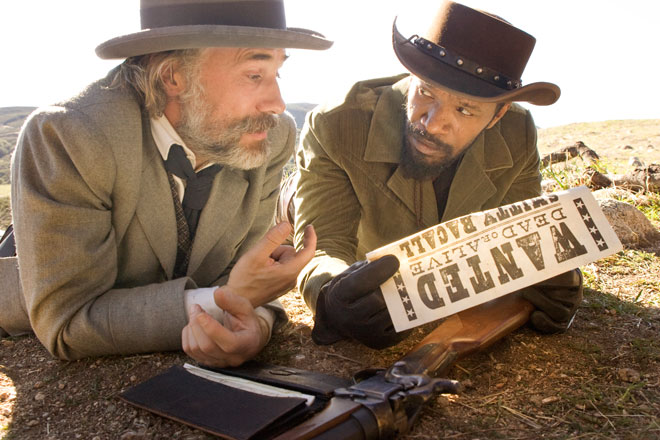
Waltz and Foxx can shoot straight in Django Unchained.


«« Django Unchained. Written and directed by Quentin Tarantino. 

It’s taken a while for this writer to get around to Quentin Tarantino’s latest opus, Django Unchained.  This has nothing to do with his craft as a filmmaker. On a tactical, scene-by-scene level, Tarantino’s work is unique. It crackles with an energy that is purely his. In an industry where the pre-sold commodity, the sure thing, is valued above everything else, he’s a special beast indeed.
            The hesitation has more to do with the theory behind all his work—namely, an aesthetic of revenge that is becoming monotonous. In such films as Kill Bill, Death Proof, Inglorious Basterds, and now Django, Tarantino ransacks the trashier side of film history to construct elaborate visions of retribution—veritable Grand Guignols of vengeance. Indeed, by his self-justifying moral calculus, the more horrid the original insult, the more baroquely over-the-top the revenge is entitled to be. The result is that Tarantino has it both ways: he gets to envision Nazis slaughtering Jews (as in Basterds) or whites abusing blacks (as in Django) with all the vivid detail of proper, old-fashioned exploitation—as long as he balances his moral books by turning the tables later, with even more blood, more extreme prejudice.
            On a certain level—the level, one supposes, of grown men who have never matured beyond their teenage years—all that can seem pretty profound. It’s a level where one of the oldest morals in all of storytelling, of the essential emptiness of vengeance, has never occurred to anybody. And there’s no shortage of historical inspiration, either: a whole raft of possible Tarantino projects await (whites vs. Indians, Jews vs. Arabs, Christians vs. Muslims, Hatfields vs. McCoys, etc.) where he can go on reducing even the saddest of conflicts into his own brand of vengeance porn. “My hands are clean,” Tarantino seems to say, after the ex-victims splatter the blood of their enemies all over the audience. It’s as predictable as Christmas.
            This time he ransacks the spaghetti westerns of the 1960’s, such as the Franco Nero Django (1966), marries it to the hyper-violence of Sam Peckinpah (The Wild Bunch, 1969), and breeds his usual low-art, high-artifice story of Django (Jamie Foxx), a slave who becomes a bounty-hunter. Django’s teacher in the trade is Dr. King Schultz (Christoph Waltz), a German immigrant who gives up dentistry for tracking down outlaws. Django turns out to be a natural marksman, an expert rider, and can even read—skills that seem odd in a lifelong field slave, but are useful enough to the good doctor. Soon the mismatched pair are turning heads from Texas to Tennessee, bagging fugitives for cash. “Kill white folks and get paid for it?” muses Django. “What’s not to like?” (Got to wonder why King never seems to go after black outlaws, but never mind.)
            This being a Tarantino opus, vengeance must figure somewhere, and does as they hatch a plan to rescue Django’s wife Hilda (Kerry Washington) from a Mississippi plantation owned by the genteel yet debauched Calvin Candie (Leonardo DiCaprio). Candie is another in Tarantino’s gallery of loquacious rogues, fond of brandy and cigars and forcing his slaves to fight to the death bare-handed on his parlor floor. It’s probably not a spoiler to reveal that things end bloodily, with stacks of corpses among those who formerly did the stacking, and Django riding into the sunset to the sound of Jim Croce’s “I Got a Name”.
            Not so much a remake of the 1966 Django as a riff on its mannerisms, the film reconstructs the same color palette, the same taste for whip pans and crash zooms. In short, it is completely ironic, über-cool…and utterly predictable. You’d think it impossible for a movie that includes numerous knee-cappings, disembowelings, whippings and gunshots to the crotch to be dull, but Django Unchained tests that proposition. At two hours and forty-five minutes, it takes almost as long to play out as a double feature of the original Django plus A Fistful of Dollars. It feels longer.
            As in Inglorious Basterds, the silkily appealing Christoph Waltz lends an incongruous presence that, in Tarantino’s pulpy universe, amounts to a breath of fresh air. Samuel L. Jackson also does a memorable—if grotesque—turn as the “house nigger” from Hell, ably and proudly embodying the worst clichés of black race betrayal. Both are better than Jamie Foxx, who seems a bit bewildered in a difficult role.
            In the end, Django is the work of a talented director who is just too enamored of his tricks to grow up. What’s it going to take for Tarantino to stop exploiting exploitation? In this, there’s some precedent for change: Clint Eastwood, himself a veteran of spaghetti Westerns, basically cashed in on exploitative drivel for decades until, at the age of 62, he directed Unforgiven. The obverse of everything he had vulgarized over his career, Unforgiven was a cosmological Western about—aptly enough—the tragic futility of vengeance. It launched Eastwood’s career as a “serious” filmmaker.
            Tarantino is not yet 50, so he’s got time yet to surprise us, to make his own Unforgiven. We can always hope.
© 2013 Nicholas Nicastro

Wednesday, January 23, 2013

Swept Away


Rum swizzles are cancelled in The Impossible.

««« The Impossible. Written by Sergio G. Sánchez & María Belón. Directed by Juan Antonio Bayona

The 2004 Indian Ocean tsunami is the biggest human disaster you’ve likely forgotten about. We’ve never stopped talking about 9-11, but the scale of devastation left by the tsunami dwarfs it: the energy released by the magnitude 9.0 temblor that caused the wave was equivalent to 23,000 Hiroshima nuclear bombs. The entire planet shook on its axis with the force of the quake. In sheer loss of life, the tsunami was equivalent to one hundred 9-11s. Fully one third of the 280,000 total casualties were children.
            Interestingly, though Hollywood has repeatedly and gleefully imagined the end of the world recently, the real-life apocalypse in East Asia has gotten scant attention. If we want to be cynical, we might blame this on the fact that it happened in faraway places that most Americans don’t care about, among poor, brown-skinned people they usually see only in the background of travel posters. Instead, it has taken a relatively low-budget ($45 million) European co-production and Spanish director Juan Antonio Bayona (The Orphanage) to remind American audiences of this mega-disaster.
            Full disclosure: though Bayona’s The Impossible is well-crafted, heartfelt, and a true revelation about what it took to survive such an event, it isn’t an easy film to watch. This is the kind of story we appreciate—both aesthetically and in substance—more than we enjoy. The lead performance by Naomi Watts is emblematic: as the mother in a Western family caught in the wave, Watts is hurled through a window, tumbled, raked, dragged, pierced, marooned, and half-drowned—all in the first fifteen minutes. Not since Robert De Niro made a punching-bag of himself in Raging Bull has a star taken this kind of sustained pummeling. As she spends the rest of the story searching for her missing husband (Ewan MacGregor) and children, Watts’ body takes on the appearance of ripe plum that’s been run through a spin cycle a few dozen times. It’s an extraordinarily performance, committed without a hint of vanity or self-consciousness (and, incidentally, nominated for an Oscar). But it isn’t like enjoying Meryl Streep master yet another foreign accent.
            Instead of trying to encompass the enormity of it all, Bayona and writers Sergio G. Sánchez and María Belón keep the focus squarely on one family. This is clever, as the viewer is invited to extrapolate from the narrow frame and, with a little imagination, suspect the full magnitude of what occurred. Along the way, Bayona is almost Spielbergian in his skill at letting small details foreshadow big threats. The blender mixing up drinks at their resort suddenly goes silent; palm trees in the distance seem to kneel down before some hidden force—and then the wave is on them all.
            The narrow focus has one unfortunate side-effect, though. The vast majority of victims were Indonesians, Sri Lankans, Indians and Thais, not Westerners. Though Bayona does show the natives, both as casualties and committing selfless acts of kindness, they are overwhelmingly kept in the background. However well-intentioned, The Impossible perpetuates the notion that history only really happens when it happens to be people who look like us.
            Not that I’ll ever be seeing this film again. Coming out of the theater, I felt like Naomi Watts looked—wrung out and psychically bruised. No pain, no gain.
@ 2013 Nicholas Nicastro

Wednesday, January 16, 2013

The Condo of Darkness

The war on terror presented through a glass darkly in Zero Dark Thirty

««1/2   Zero Dark Thirty. Written by Mark Boal. Directed by Kathryn Bigelow. 

They say success has many fathers, but failure is an orphan. In the case of the decade-long hunt for Obama bin Laden, success also has a mother: the anonymous intelligence analyst depicted as “Maya” in Kathryn Bigelow’s Zero Dark Thirty. The role of the real-life Maya in the search that culminated in the May, 2011 killing of bin Laden at his compound in Pakistan is a matter of wide discussion. Nor is it the only one: for implying that crucial information was obtained through torture, Bigelow’s film has provoked a Senate investigation of its sources in the CIA. All this press certainly hasn’t hurt Thirty at the box office, where it out-earned the work of another guy who’s been known to indulge in enhanced entertainment techniques, Quentin Tarantino.
            Notoriety is rarely substance and Bigelow’s film is no exception. Despite the high-level security clearances and references to 9-11, this is really just a police procedural about a very shy fugitive. For the most part, we watch this movie in order to watch the heroine (Jessica Chastain) process video feeds, glower significantly, and make a pest of herself to her superiors. Take away the searing topicality and it’s doubtful the film would have been made in the first place. Take away bin Laden’s name and it would be downright dull.
            True, actual intelligence work is a meticulous craft, demanding not 007 heroics but patient spadework with facts and probabilities. As Bigelow presents her, Maya is not just good at her job but ferociously driven—a flame-haired Fury of counter-terrorism. For 10 years (but in real life, only five), she kept at the task, keeping the torch of vengeance alive even as her bosses seemed to lose interest. Mostly through her physical presence, Chastain does as much with this deliberately one-dimensional character as she can. When Leon Panetta (played here by a laughingly bewigged James Gandolfini) demands to know why she deserves a seat at the big table for discussions of bin Laden’s hideout, she replies “Because I’m the motherfucker who found the place…sir”.
            If this was just a story of about a mid-level bureaucrat who sacrifices her life for a cruel but just cause, we might had seen more of what Maya gave up to get her man. We’d learn what opportunities she passed on, what relationships she gave up. Who is Maya, really, and what makes her so different from the others? But beyond saying what she isn’t (“I’m not that girl,” she declares, “the girl who fucks…”) this isn’t the story Bigelow wants to tell. This is ostensibly because she and screenwriter Mark Boal were determined not to make Maya’s real CIA counterpart recognizable in any way.
            One obvious option would have been to fictionalize a back story for her. Instead, Bigelow pads out the story with long scenes of Maya and a colleague (Jason Clarke) torturing a detainee (Reda Kateb) using water-boarding, stress positions, and sexual humiliation. That these are the scenes that have sparked the most discussion is ironic, given that only the barest sliver of a hint to bin Laden’s whereabouts come from torture, and in fact only after, when the guy makes a casual reference over lunch. Bigelow and Boal insist they don’t condone torture, arguing that the scenes are there to show the full range of “tools” the agency was willing to use in the hunt. But this is hardly convincing, given that they never bother to show what the brutality really costs the torturers, let alone the tortured. There’s barely a hint of discussion about the actual efficacy of stringing people up for information.
            Mostly, the water-boarding seems to be in there because the rest of the manhunt is so visually dull—just Maya in her cubicle, staring at computer screens—and because the filmmakers don’t dare make her a rounded, complete person. So really, where else could they go? The filmmakers trap themselves in an unresolveable dilemma: if the torture is presented as effective, then the film is a lie; if it isn’t effective, it’s gratuitous.
            The film finally does take off when Seal Team Six sets off on its mission at “zero dark thirty” (that’s military slang for “sometime after midnight”). It’s in these final forty minutes or so that we glimpse the flair Bigelow showed in The Hurt Locker—the tightly-wound physicality she releases only in spasms, as the raiders creep deeper into bin Laden’s condo of darkness. There’s a fitting symmetry there, as the payback comes from above on the guy who attacked us from the air.
            Yet even here there’s a sense of dissatisfaction. Maya can’t go on the commando raid she set in motion. For two hours her primary dramatic function is not to act herself, but to beg and plead for others to act. As the helicopters take off and all that is about to end, she seems more reflective than frustrated, as if this were all happening to someone else.          
            Military protocol might dictate that Maya remain passive. But Bigelow might have found a way to make this final thwarting feel as tragic as it was. Or at least as compelling as stuffing a wet towel down a guy’s throat.
© 2013 Nicholas Nicastro

Thursday, January 10, 2013

My Cherie Amour Fou

Lawrence and Cooper are out-patient and in love in Silver Linings Playbook.

««1/2  Silver Linings Playbook. Written by David O. Russell, based on a novel by Matthew Quick. Directed by David O. Russell.  

Many people still don’t think of mental illness as “real” illness. Want proof?  Think about the movies and TV shows out there about characters with some chronic physical disease who miraculously recover because they met their soul-mate. There aren’t many, because the idea is absurd—lucking into that girl with fetching dimples or that guy with the winning smile is nice, but it won’t cure your cancer. Ali McGraw was sick and plenty in love in Love Story, and she still died.
            But in movies like David O. Russell’s Silver Linings Playbook, mental health is really just a matter of global attitude adjustment. The power of psychoanalysis, drug treatments, behavioral modification all pale next to the bluebird of happiness. Indeed, not only is mental health just a yank on the bootstrap away, it has become a handy obstacle to be overcome on the way to romantic remission. In classic literature from Shakespeare to Hemingway, barriers of political or class or family kept star cross’d lovers apart. With those social obstacles largely irrelevant now, only our own psychoses and neuroses—how much we are “damaged goods”—really stand in the way of “ever after”.
            In a world of Wes Andersons and Todd Solondzes, Russell (Spanking the Monkey, Flirting With Disaster, Three Kings) is still no slouch in the quirkiness department. His version of the Matthew Quick novel gives us Bradley Cooper as Pat, an ex-teacher of history who went a ways around the bend after discovering his wife in flagrante with a colleague. We meet him after he’s spent eight court-mandated months in an institution, still trying to get over the violent rage he feels whenever he hears Stevie Wonder’s “My Cherie Amour”—the tune that was playing the moment he discovered spouse and lover in the shower. (No word whether he also goes berserk at the Jermaine Jackson and Andy Williams covers of that song too.)
This concept is just one step above the old Abbot and Costello “slowly I turned…” routine, where Abbott assaults Costello when the latter says the trigger word. Fortunately, Cooper (The Hangover, Limitless) is likeable enough to make the role work, right down to the character’s pie-in-the-sky dreams of winning back his wife and his old job. He’s matched quirk-for-quirk and symptom-for-symptom by a pugnacious and fetching Jennifer Lawrence, whose Tiffany is coping with young widowhood and temporary nymphomania. They’re both barking mad, but clash companionably.
The unconvincing part of this lies in the redemption, which somehow involves a dance competition against professionals that Pat and Tiffany would never qualify for, with results that would put the makers of Xanax and Abilify out of business. It’s not the notion of crazy love that takes Russell’s screenplay a bridge too far—it’s the idea that crazy love makes lovers sane, instead of just more crazy. In the end, Russell only proves that he never took his characters’ peculiarities seriously in the first place.
All of which is a shame, because Cooper and Lawrence seem to have real chemistry. Robert De Niro comes along in his best Meet the Parents comedic supporting mode, and Chris Tucker is pleasantly non-screechy as Pat’s somewhat crazier in-mate. (No doubt only guys like Tucker or Chris Rock could get away with telling Cooper to “black it up” as he practices his dance routine.)  
Russell is on the side of the angels as he continues to tell character-driven stories about live, non-CGI figures. Unfortunately, for a film about “silver linings”, Playbook’s virtues are all of the surface.  
© 2013 Nicholas Nicastro