Wednesday, January 30, 2013

There Will Be Blood

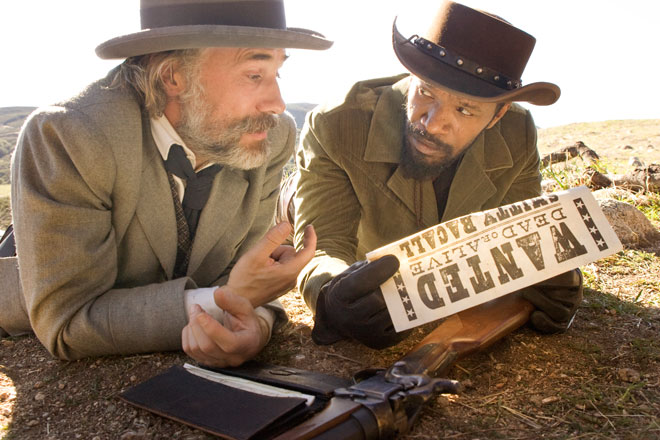
Waltz and Foxx can shoot straight in Django Unchained.


«« Django Unchained. Written and directed by Quentin Tarantino. 

It’s taken a while for this writer to get around to Quentin Tarantino’s latest opus, Django Unchained.  This has nothing to do with his craft as a filmmaker. On a tactical, scene-by-scene level, Tarantino’s work is unique. It crackles with an energy that is purely his. In an industry where the pre-sold commodity, the sure thing, is valued above everything else, he’s a special beast indeed.
            The hesitation has more to do with the theory behind all his work—namely, an aesthetic of revenge that is becoming monotonous. In such films as Kill Bill, Death Proof, Inglorious Basterds, and now Django, Tarantino ransacks the trashier side of film history to construct elaborate visions of retribution—veritable Grand Guignols of vengeance. Indeed, by his self-justifying moral calculus, the more horrid the original insult, the more baroquely over-the-top the revenge is entitled to be. The result is that Tarantino has it both ways: he gets to envision Nazis slaughtering Jews (as in Basterds) or whites abusing blacks (as in Django) with all the vivid detail of proper, old-fashioned exploitation—as long as he balances his moral books by turning the tables later, with even more blood, more extreme prejudice.
            On a certain level—the level, one supposes, of grown men who have never matured beyond their teenage years—all that can seem pretty profound. It’s a level where one of the oldest morals in all of storytelling, of the essential emptiness of vengeance, has never occurred to anybody. And there’s no shortage of historical inspiration, either: a whole raft of possible Tarantino projects await (whites vs. Indians, Jews vs. Arabs, Christians vs. Muslims, Hatfields vs. McCoys, etc.) where he can go on reducing even the saddest of conflicts into his own brand of vengeance porn. “My hands are clean,” Tarantino seems to say, after the ex-victims splatter the blood of their enemies all over the audience. It’s as predictable as Christmas.
            This time he ransacks the spaghetti westerns of the 1960’s, such as the Franco Nero Django (1966), marries it to the hyper-violence of Sam Peckinpah (The Wild Bunch, 1969), and breeds his usual low-art, high-artifice story of Django (Jamie Foxx), a slave who becomes a bounty-hunter. Django’s teacher in the trade is Dr. King Schultz (Christoph Waltz), a German immigrant who gives up dentistry for tracking down outlaws. Django turns out to be a natural marksman, an expert rider, and can even read—skills that seem odd in a lifelong field slave, but are useful enough to the good doctor. Soon the mismatched pair are turning heads from Texas to Tennessee, bagging fugitives for cash. “Kill white folks and get paid for it?” muses Django. “What’s not to like?” (Got to wonder why King never seems to go after black outlaws, but never mind.)
            This being a Tarantino opus, vengeance must figure somewhere, and does as they hatch a plan to rescue Django’s wife Hilda (Kerry Washington) from a Mississippi plantation owned by the genteel yet debauched Calvin Candie (Leonardo DiCaprio). Candie is another in Tarantino’s gallery of loquacious rogues, fond of brandy and cigars and forcing his slaves to fight to the death bare-handed on his parlor floor. It’s probably not a spoiler to reveal that things end bloodily, with stacks of corpses among those who formerly did the stacking, and Django riding into the sunset to the sound of Jim Croce’s “I Got a Name”.
            Not so much a remake of the 1966 Django as a riff on its mannerisms, the film reconstructs the same color palette, the same taste for whip pans and crash zooms. In short, it is completely ironic, über-cool…and utterly predictable. You’d think it impossible for a movie that includes numerous knee-cappings, disembowelings, whippings and gunshots to the crotch to be dull, but Django Unchained tests that proposition. At two hours and forty-five minutes, it takes almost as long to play out as a double feature of the original Django plus A Fistful of Dollars. It feels longer.
            As in Inglorious Basterds, the silkily appealing Christoph Waltz lends an incongruous presence that, in Tarantino’s pulpy universe, amounts to a breath of fresh air. Samuel L. Jackson also does a memorable—if grotesque—turn as the “house nigger” from Hell, ably and proudly embodying the worst clichés of black race betrayal. Both are better than Jamie Foxx, who seems a bit bewildered in a difficult role.
            In the end, Django is the work of a talented director who is just too enamored of his tricks to grow up. What’s it going to take for Tarantino to stop exploiting exploitation? In this, there’s some precedent for change: Clint Eastwood, himself a veteran of spaghetti Westerns, basically cashed in on exploitative drivel for decades until, at the age of 62, he directed Unforgiven. The obverse of everything he had vulgarized over his career, Unforgiven was a cosmological Western about—aptly enough—the tragic futility of vengeance. It launched Eastwood’s career as a “serious” filmmaker.
            Tarantino is not yet 50, so he’s got time yet to surprise us, to make his own Unforgiven. We can always hope.
© 2013 Nicholas Nicastro

Wednesday, January 23, 2013

Swept Away


Rum swizzles are cancelled in The Impossible.

««« The Impossible. Written by Sergio G. Sánchez & María Belón. Directed by Juan Antonio Bayona

The 2004 Indian Ocean tsunami is the biggest human disaster you’ve likely forgotten about. We’ve never stopped talking about 9-11, but the scale of devastation left by the tsunami dwarfs it: the energy released by the magnitude 9.0 temblor that caused the wave was equivalent to 23,000 Hiroshima nuclear bombs. The entire planet shook on its axis with the force of the quake. In sheer loss of life, the tsunami was equivalent to one hundred 9-11s. Fully one third of the 280,000 total casualties were children.
            Interestingly, though Hollywood has repeatedly and gleefully imagined the end of the world recently, the real-life apocalypse in East Asia has gotten scant attention. If we want to be cynical, we might blame this on the fact that it happened in faraway places that most Americans don’t care about, among poor, brown-skinned people they usually see only in the background of travel posters. Instead, it has taken a relatively low-budget ($45 million) European co-production and Spanish director Juan Antonio Bayona (The Orphanage) to remind American audiences of this mega-disaster.
            Full disclosure: though Bayona’s The Impossible is well-crafted, heartfelt, and a true revelation about what it took to survive such an event, it isn’t an easy film to watch. This is the kind of story we appreciate—both aesthetically and in substance—more than we enjoy. The lead performance by Naomi Watts is emblematic: as the mother in a Western family caught in the wave, Watts is hurled through a window, tumbled, raked, dragged, pierced, marooned, and half-drowned—all in the first fifteen minutes. Not since Robert De Niro made a punching-bag of himself in Raging Bull has a star taken this kind of sustained pummeling. As she spends the rest of the story searching for her missing husband (Ewan MacGregor) and children, Watts’ body takes on the appearance of ripe plum that’s been run through a spin cycle a few dozen times. It’s an extraordinarily performance, committed without a hint of vanity or self-consciousness (and, incidentally, nominated for an Oscar). But it isn’t like enjoying Meryl Streep master yet another foreign accent.
            Instead of trying to encompass the enormity of it all, Bayona and writers Sergio G. Sánchez and María Belón keep the focus squarely on one family. This is clever, as the viewer is invited to extrapolate from the narrow frame and, with a little imagination, suspect the full magnitude of what occurred. Along the way, Bayona is almost Spielbergian in his skill at letting small details foreshadow big threats. The blender mixing up drinks at their resort suddenly goes silent; palm trees in the distance seem to kneel down before some hidden force—and then the wave is on them all.
            The narrow focus has one unfortunate side-effect, though. The vast majority of victims were Indonesians, Sri Lankans, Indians and Thais, not Westerners. Though Bayona does show the natives, both as casualties and committing selfless acts of kindness, they are overwhelmingly kept in the background. However well-intentioned, The Impossible perpetuates the notion that history only really happens when it happens to be people who look like us.
            Not that I’ll ever be seeing this film again. Coming out of the theater, I felt like Naomi Watts looked—wrung out and psychically bruised. No pain, no gain.
@ 2013 Nicholas Nicastro

Wednesday, January 16, 2013

The Condo of Darkness

The war on terror presented through a glass darkly in Zero Dark Thirty

««1/2   Zero Dark Thirty. Written by Mark Boal. Directed by Kathryn Bigelow. 

They say success has many fathers, but failure is an orphan. In the case of the decade-long hunt for Obama bin Laden, success also has a mother: the anonymous intelligence analyst depicted as “Maya” in Kathryn Bigelow’s Zero Dark Thirty. The role of the real-life Maya in the search that culminated in the May, 2011 killing of bin Laden at his compound in Pakistan is a matter of wide discussion. Nor is it the only one: for implying that crucial information was obtained through torture, Bigelow’s film has provoked a Senate investigation of its sources in the CIA. All this press certainly hasn’t hurt Thirty at the box office, where it out-earned the work of another guy who’s been known to indulge in enhanced entertainment techniques, Quentin Tarantino.
            Notoriety is rarely substance and Bigelow’s film is no exception. Despite the high-level security clearances and references to 9-11, this is really just a police procedural about a very shy fugitive. For the most part, we watch this movie in order to watch the heroine (Jessica Chastain) process video feeds, glower significantly, and make a pest of herself to her superiors. Take away the searing topicality and it’s doubtful the film would have been made in the first place. Take away bin Laden’s name and it would be downright dull.
            True, actual intelligence work is a meticulous craft, demanding not 007 heroics but patient spadework with facts and probabilities. As Bigelow presents her, Maya is not just good at her job but ferociously driven—a flame-haired Fury of counter-terrorism. For 10 years (but in real life, only five), she kept at the task, keeping the torch of vengeance alive even as her bosses seemed to lose interest. Mostly through her physical presence, Chastain does as much with this deliberately one-dimensional character as she can. When Leon Panetta (played here by a laughingly bewigged James Gandolfini) demands to know why she deserves a seat at the big table for discussions of bin Laden’s hideout, she replies “Because I’m the motherfucker who found the place…sir”.
            If this was just a story of about a mid-level bureaucrat who sacrifices her life for a cruel but just cause, we might had seen more of what Maya gave up to get her man. We’d learn what opportunities she passed on, what relationships she gave up. Who is Maya, really, and what makes her so different from the others? But beyond saying what she isn’t (“I’m not that girl,” she declares, “the girl who fucks…”) this isn’t the story Bigelow wants to tell. This is ostensibly because she and screenwriter Mark Boal were determined not to make Maya’s real CIA counterpart recognizable in any way.
            One obvious option would have been to fictionalize a back story for her. Instead, Bigelow pads out the story with long scenes of Maya and a colleague (Jason Clarke) torturing a detainee (Reda Kateb) using water-boarding, stress positions, and sexual humiliation. That these are the scenes that have sparked the most discussion is ironic, given that only the barest sliver of a hint to bin Laden’s whereabouts come from torture, and in fact only after, when the guy makes a casual reference over lunch. Bigelow and Boal insist they don’t condone torture, arguing that the scenes are there to show the full range of “tools” the agency was willing to use in the hunt. But this is hardly convincing, given that they never bother to show what the brutality really costs the torturers, let alone the tortured. There’s barely a hint of discussion about the actual efficacy of stringing people up for information.
            Mostly, the water-boarding seems to be in there because the rest of the manhunt is so visually dull—just Maya in her cubicle, staring at computer screens—and because the filmmakers don’t dare make her a rounded, complete person. So really, where else could they go? The filmmakers trap themselves in an unresolveable dilemma: if the torture is presented as effective, then the film is a lie; if it isn’t effective, it’s gratuitous.
            The film finally does take off when Seal Team Six sets off on its mission at “zero dark thirty” (that’s military slang for “sometime after midnight”). It’s in these final forty minutes or so that we glimpse the flair Bigelow showed in The Hurt Locker—the tightly-wound physicality she releases only in spasms, as the raiders creep deeper into bin Laden’s condo of darkness. There’s a fitting symmetry there, as the payback comes from above on the guy who attacked us from the air.
            Yet even here there’s a sense of dissatisfaction. Maya can’t go on the commando raid she set in motion. For two hours her primary dramatic function is not to act herself, but to beg and plead for others to act. As the helicopters take off and all that is about to end, she seems more reflective than frustrated, as if this were all happening to someone else.          
            Military protocol might dictate that Maya remain passive. But Bigelow might have found a way to make this final thwarting feel as tragic as it was. Or at least as compelling as stuffing a wet towel down a guy’s throat.
© 2013 Nicholas Nicastro

Thursday, January 10, 2013

My Cherie Amour Fou

Lawrence and Cooper are out-patient and in love in Silver Linings Playbook.

««1/2  Silver Linings Playbook. Written by David O. Russell, based on a novel by Matthew Quick. Directed by David O. Russell.  

Many people still don’t think of mental illness as “real” illness. Want proof?  Think about the movies and TV shows out there about characters with some chronic physical disease who miraculously recover because they met their soul-mate. There aren’t many, because the idea is absurd—lucking into that girl with fetching dimples or that guy with the winning smile is nice, but it won’t cure your cancer. Ali McGraw was sick and plenty in love in Love Story, and she still died.
            But in movies like David O. Russell’s Silver Linings Playbook, mental health is really just a matter of global attitude adjustment. The power of psychoanalysis, drug treatments, behavioral modification all pale next to the bluebird of happiness. Indeed, not only is mental health just a yank on the bootstrap away, it has become a handy obstacle to be overcome on the way to romantic remission. In classic literature from Shakespeare to Hemingway, barriers of political or class or family kept star cross’d lovers apart. With those social obstacles largely irrelevant now, only our own psychoses and neuroses—how much we are “damaged goods”—really stand in the way of “ever after”.
            In a world of Wes Andersons and Todd Solondzes, Russell (Spanking the Monkey, Flirting With Disaster, Three Kings) is still no slouch in the quirkiness department. His version of the Matthew Quick novel gives us Bradley Cooper as Pat, an ex-teacher of history who went a ways around the bend after discovering his wife in flagrante with a colleague. We meet him after he’s spent eight court-mandated months in an institution, still trying to get over the violent rage he feels whenever he hears Stevie Wonder’s “My Cherie Amour”—the tune that was playing the moment he discovered spouse and lover in the shower. (No word whether he also goes berserk at the Jermaine Jackson and Andy Williams covers of that song too.)
This concept is just one step above the old Abbot and Costello “slowly I turned…” routine, where Abbott assaults Costello when the latter says the trigger word. Fortunately, Cooper (The Hangover, Limitless) is likeable enough to make the role work, right down to the character’s pie-in-the-sky dreams of winning back his wife and his old job. He’s matched quirk-for-quirk and symptom-for-symptom by a pugnacious and fetching Jennifer Lawrence, whose Tiffany is coping with young widowhood and temporary nymphomania. They’re both barking mad, but clash companionably.
The unconvincing part of this lies in the redemption, which somehow involves a dance competition against professionals that Pat and Tiffany would never qualify for, with results that would put the makers of Xanax and Abilify out of business. It’s not the notion of crazy love that takes Russell’s screenplay a bridge too far—it’s the idea that crazy love makes lovers sane, instead of just more crazy. In the end, Russell only proves that he never took his characters’ peculiarities seriously in the first place.
All of which is a shame, because Cooper and Lawrence seem to have real chemistry. Robert De Niro comes along in his best Meet the Parents comedic supporting mode, and Chris Tucker is pleasantly non-screechy as Pat’s somewhat crazier in-mate. (No doubt only guys like Tucker or Chris Rock could get away with telling Cooper to “black it up” as he practices his dance routine.)  
Russell is on the side of the angels as he continues to tell character-driven stories about live, non-CGI figures. Unfortunately, for a film about “silver linings”, Playbook’s virtues are all of the surface.  
© 2013 Nicholas Nicastro

Tuesday, December 18, 2012

Not So Precious

Bilbo (Martin Freeman) and his band of fun-size Klingons

««  The Hobbit: An Unexpected Journey. Written by Fran Walsh, Philippa Boyens, Peter Jackson & Guillermo del Toro, based on the novel by J.R.R. Tolkien. Directed by Peter Jackson. 

When the first installment in Peter Jackson’s Lord of the Rings trilogy appeared in 2001, it was just two months since the shock of 9-11. Tolkien’s classic, though set in a Middle Earth of hobbits, elves and orcs, turned out to be perfectly in tune with the zeitgeist—a dark, sprawling epic about decent people preparing for an existential struggle against an utterly alien, implacable enemy. This surprising topicality, and Jackson’s sure control over his massive material, helped make the Rings movies both box office and critical successes. Nobody questioned why he needed three long movies to tell this story, and nobody minded waiting three years for the epic’s conclusion.
            The unexpected thing about Jackson’s The Hobbit: An Unexpected Journey is that this writer was bored not by the third year, but by the second hour. The main problem, alas, is more-or-less baked into the project: because The Hobbit was written before the Rings, and is set before the momentous events of the trio, Jackson is essentially giving us the appetizer after the meal.
            Indeed, the literary Hobbit is a different sort of work than the others. It’s a light book, almost whimsical in the telling, and it tells a story with stakes that are far, far lower. The story, about a band of merry dwarves who enlist the reluctant hobbit Bilbo Baggins (Martin Freeman) to steal some treasure from a nasty dragon, clearly called for a different kind of tone. No existential struggle, no ancient evil. When characters are dubbed “Fili” and “Kili”, “Oin” and “Gloin” and “Nori” and “Dori”, we aren’t talking On the Beach, are we?
            Like in the other movies, there’s a lot of wandering over big landscapes here, and a few big action set-pieces that are, alas, never quite as involving. Once again, we break our journey in Lórien, the Elvish empyrean that looks like an all-inclusive five-star resort, and meet the enchanting Galadriel (Cate Blanchett), whom Jackson poses against the sunset like a piece of garden sculpture. There are a few compensations: Freeman is just fine as the modest, level-headed Bilbo, who hungers for an extraordinary life while suspecting he’s too far over (or under) the hill to pull it off. Unlike the eager-beaver Frodo, Bilbo is like a forty-five year-old struggling with the urge to join the Peace Corps. Ian McKellen is back as Gandalf, and is welcome merely for being exactly as he was before. We also get to see what a decade of additional development in motion-capture technology has done to make Gollum (Andy Serkis) an even more remarkable creation.
            But let’s clear away the pipeweed and face facts: in almost three hours, this movie gets through less than half of a book that was already light to begin with. In the annals of movie adaptations, this is unique—a script twice as long as the number of prose pages it adapts. If someone had turned the first half of The Little Prince into a ninety-minute cable TV event, it would not be as overblown a project as The Hobbit.
            For that, we get the set-up for what is essentially a heist story, but no actual heist. Instead, we’re expected to care naturally for a band of dwarves who look a little too much like fun-size Klingons. Add to that a few other dubious creations, such as a jowly Orc king who looks too much like a similar character in The Phantom Menace, and we have to wonder not only if Jackson believes we’re seen any other movies, but whether he’s seen any himself.
            The world feels different since 2001. Sauron is dead—shot in the neck by Seal Team Six. Mordor has a shaky but real democratic regime. There are still wars going on, but not so much fear that our struggle has existential stakes. Tolkien fans are, of course, delighted to see anything set in Middle Earth reach the big screen. The rest of us, however, have moved on, and are ready for a different take on the Tolkien universe. Jackson insists on sticking to the formula of the other movies, shoe-horning material from other Tolkien writings that have little directly to do with the dwarves or their quest. In a sense, Jackson disrespects The Hobbit by making it an excuse for a new series of highly lucrative Ring prequels. It seems it’s not only Smaug the dragon who covets treasure above all else.
            Early in The Hobbit Gandalf tells Bilbo “Every good tale deserves embellishment.” Perhaps—as long as we’re convinced there’s a good tale in the offing. Jackson hasn’t made his case yet.  
© 2012 Nicholas Nicastro

Wednesday, December 12, 2012

First Blood

Bordan and friend in Battlestar Galactica: Blood and Chrome

«««  Battlestar Galactica: Blood and Chrome. Created by Michael Taylor & David Eick. Based on the Syfy series Caprica and Battlestar Galactica. Available for streaming at www.machinima.com, and coming in February on Syfy.

After the demise of Caprica in 2010, there were ample grounds to doubt there was any life left in Syfy’s rebooted Battlestar Galactica. The mixed response to the original series’ finale, and the failure of creator Ronald D. Moore’s attempt to reach beyond Galactica’s core fanboy audience with his Caprica prequel, seemed to leave BSG without a plausible future or prehistory. The franchise was, in a word, fracked.
            Turns out series’ co-creator David Eick isn’t done trying. The pilot for the new BSG: Blood and Chrome was released online last month, and is available for steaming on Machinima.com and Youtube. Viewing it on a computer screen, chopped up in ten-minute increments, isn’t the ideal experience, but there are less rewarding ways to spend a couple of hours in front of a computer.
            Blood and Chrome is, to mangle a phrase, a “middle origin story”—an account of the early wartime career of the young man who would grow up to be Commander William Adama (Edward James Olmos). The setting is the thick of the penultimate Cylon War, as human civilization seems destined to be conquered by its silicon-based spawn. The young Adama (Luke Pasqualino) is fresh out of the academy and eager to kill the “toasters”, but his career path takes a detour when he’s not assigned to combat duty at all. Instead, he’s saddled with a cargo run that seems designed to take him as far from the action as possible. On board are his co-pilot “Coker” Fasjovik (Ben Cotton)—a short-timer with an allergy to risks—and a quiet, spooky engineer (Lili Bordán) who is clearly hoarding secrets.
            Obviously, the mission doesn’t stay far from the action for long. And suffice it to say that, as prequels to hit shows go, Blood and Chrome is a credible effort. Where Caprica seemed to actively disdain the action-packed, high-stakes drama of the original show, this one embraces the pressure-cooker intensity that gave BSG its addictive momentum. As for the mystic “prophecy” of the original, the classic rock tunes playing in people’s heads and hand-waving about “god’s will”, some might think B&C better for avoiding all that. It’s just fleeing and fighting here, folks, with just a dash of that third “f—ing” thrown in for variety.
            As several critics have noted, though, this makes for a strange pilot for a projected series. The education of the young, ingenuous Adama in the subtler arts of war is a promising prospect, considering what a master of unconventional strategy he is destined to become. But B&C is tied up almost too neatly for its own good. It’s as if its makers deliberately foreshortened its prospects. And sure enough, though the full pilot will air in glorious HD on the Syfy channel this February, there are currently no plans to make it an ongoing series.
            In the end, B&C can’t avoid the usual prequels’ dilemma: when you give audiences the apocalypse in the original show, there’s not much left for a follow-up except to fill in the blanks. Those blanks are more thrilling here than in the soapish Caprica. But we still know where all this is going. 
© 2012 Nicholas Nicastro

Wednesday, December 5, 2012

The Potemkin Lover

We can't see what Knightley sees in Anna Karenina.

««  Anna Karenina. Written by Tom Stoppard, based on the novel by Leo Tolstoy. Directed by Joe Wright

Criticizing a classic like Tolstoy's Anna Karenina can be tricky, given that those who decide these things have already pronounced its greatness. Everybody is entitled to an opinion, of course, but who is confident enough to say a book like Karenina is overrated without at least some fear of looking like an uncultured boob?
            Let my boobs show, then: reading this book, I was struck by just how little of it concerns Anna Karenina. Instead of focusing on the business at hand, Tolstoy dwells on a multitude of seemingly extraneous characters, only some of whom are interesting. There's too much time spent on agricultural economics and too little on psychology. When I put it down, I couldn't help feeling the old man really needed a good editor. Between this and that other great 19th century novel of romantic illusion and marital infidelity, I have to say I prefer Madame Bovary.
            The good news about Joe Wright's new version is that the limitations of a feature-film screenplay (120 double-spaced script pages vs. 600 densely-worded pages) forced writer Tom Stoppard to focus on Karenina herself. As the doomed affair between Anna Arkadyevna Karenina (Keira Knightley) and the feckless rake Count Vronsky (Aaron Taylor-Johnson) takes center stage, Knightley's talent for suffering picturesquely can't be denied. Pretty faces, pretty costumes, the baroque opulence of Imperial Russia in the flush of its terminal rot—how can Wright miss?
            Yet miss he does. The problem starts with the decision to set the action more or less entirely on a theatrical stage, with transitions (admittedly, cleverly) indicated by shifts in camera angle, backdrop, location on the stage or out among the seats. It's the sort of thing we'd expect in an opus by Peter Greenaway or Derek Jarman, this conscious heightening of the artifice, reminding us at every turn that this is just a story, and the figures onstage merely characters. The idea seems apt enough in the abstract—the term "Potemkin village", referring to the political power of illusion, did originate in Russia.
            Problem is, the device isn’t applied just in the abstract. In practice, Wright (Pride and Prejudice, Atonement) takes it too far, making the ironic quotes around the "action" still more emphatic by indulging in outright silliness. The bureaucratic offices of Oblonsky (Matthew Macfadyen), for instance, are parodied in a goofy way we'd expect among the Oompa Loompas in Willy Wonka's chocolate factory. Goofiness and tragedy don't coexist so well: Karenina is, after all, one of the landmarks of realist fiction. Wright ultimately wants it both ways—to engage in Brechtian distancing and to make a traditional weepie out of Anna's plight. He ends up succeeding fully at neither.
            This Karenina might still have worked if we saw the heroine as Tolstoy belatedly came to see her—as misguided but sympathetic soul. The casting of Vronsky makes that impossible. With his butterscotch highlights and moisturized complexion, Taylor-Johnson looks like he belongs in a boy band more than the Czar's cavalry. Anna's decision to throw away marriage and motherhood for Vronsky might convince if we see what she does in him. Looking at Taylor-Johnson, we see only a One Direction music video. Falling so desperately for such a pouffed poodle makes Anna not tragic, but a ninny.
            It's a shame because Knightley—still young at 27—clearly has the chops to carry such hefty roles. She has the lines of a living John Singer Sargent portrait, but also enough fetching idiosyncracies, such as her faintly reptilian grin, to be interesting too. Like an instrument waiting too long to be played by a master, there's a world of potential in her sadly untapped in movies like Karenina, The Duchess, or Atonement. Knightley in a Jane Campion Madame Bovary, anyone?
© 2012 Nicholas Nicastro